Friday, July 16, 2010
Dansers exiting the Catholic Church after adoring the Virgin of Carmen

Tuesday, July 13, 2010
Hatunrumiyoc - Twelve-Angle Stone - Cuzco
The Inca stone walls throughout Cuzco and the Sacred Valley truly fascinate me. So large, so precise, no matter how many angles the cut ...... boggles my mind.

The Stone of Twelve Angles. The palace Hatunrumiyoc was built by Inca Sinchi Roca, the most important thing about this palace is the Lienzo pétreo which is a beautiful wall which bends backwards, built out of dorita verde or green stone, here you will find the famous Stone of Twelve Angles. The palace was destroyed and the only part that remains perfect is this geometric wall.
 |
| Here are noted the 12 angles of this stone. |
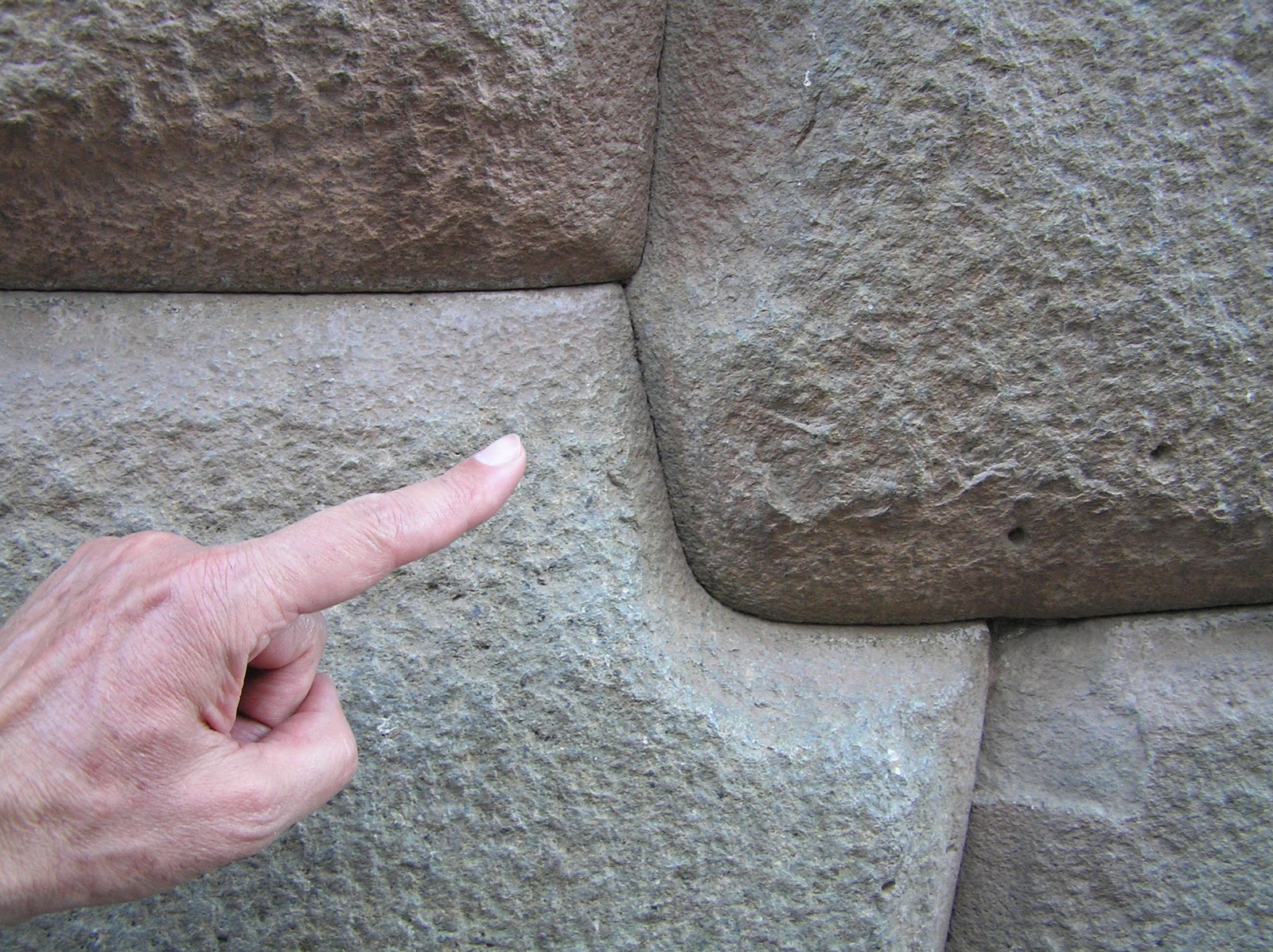 |
| The Incas' engineering medium was stone. They didn't need to use mortar to hold the walls in place. Instead, they used precise geometry to cut the stones and create tight joints. |
 |
| All the angles that went into the cutting of this one stone, and then the corresponding outer stones to make it all fit together makes this a unique stone puzzle. |


These stones are very large (hundreds of pounds if now tons) and fit together perfectly. Similar walls can be seen throughout the Sacred Valley of the Inca. The mystery of how the Inca, some 500 to 800 years ago were able to cut these massive stones with such precision that when placed one, on top of another, no matter what the angle of the cut, the stones fit together perfectly. Even now, it is impossible to slip even a knife inbetween these stones, the store work was done with such precision.

The building on the opposite side of the street (this street is maybe at best 10 feet across) from the Inca wall, was built by the Spanish. The craftmanship of the two examples of stone masonry is light years apart! The Inca were superb in their craft! The Spanish could have learned alot from the Inca ..... but that never happened.

Inca ruins of Tipon
The ruins of Tipon, located south of Cuzco were in some ways very similar to other Inca ruins I´d visited, and yet in other ways very unique. Basically, the Inca build elaborate terraces at this site, for growing potatoes. The acquaduct system was built with straight canals flowing one into an other. The acquaducts flow now as they did some 600 to 800 years ago.

By building terraces, fed by mountain water, the Inca were able ti increase vastly their production of foods.


The lines of the canals are so straight and the water flows smoothly from one canal to another. Each canal then irrigated the terrace below it.

Toward the top of the terraces, a bathing area for the nobility. The water was ...... cool if not cold.

To get from one terrace to another, the Inca built in their own stone ladders. This shot gives one an idea of how high each of these terraces was built.

The Inca ruins to Tipon are located 3,900 meters, or some 12,800 feet above sea level. That´s the valley below I´m pointing at. I can´t even imagine what it must have been like to the Inca to climb the thousands of stairs it must have took to get from the valley bottom to the top terrace....

The acquaducts that provided all the water for growing the potatoes, has four channels near the top of the terraces. It is thought these four symbolized the four directions of north, south, east and west.


At the very top, one channeland with this single channel comes a major mystery. Where does the water come from? The channel disappears into the mountain behind where I stood to take this picture. But thre are no lakes, rivers or glaciers on the mountains behind me that could possibly feed this stream. It does not snow in these mountains either. Whether it rains or not, the level of the stream stays the same. So what source of water did the Inca tap into that in this modern age, with all our technology, we can not find or figure out?

To the right of the terraces, were some Inca buildings. I looked up.... and there were Shaman on their way to bless the buildings through a despacho..... offerings to Mother Earth.


As quickly as they had come, the Shaman were gone.
Monday, July 12, 2010
Pre Inca military center of Pilillacta
 |
| Pikillacta was a very large military post, with some 3000 inhabitants. Security was paramount for the Wari solders who lived here, so the entrance gate was made very samll. |
 |
| It is believed these stone walls were another 6 to 7 feet taller than they are now. |
 |
| To move from a main street to quarters inside this facility, the path takes on a labyrinth type approach .... no direct route, rather one had to go one direction, then back trak on another path.... all for the security of this facility and its inhabitants. |
 |
| These basement living quarters for the solders, were also part of the facilities security measure. Two men probably lived in each section. By these living quarters being underground, should the facility ever be attacked, the underground provided more safety. |
 |
| The Great Wall of Pikillacta! As archeologists suggest, 6 or more feet could be added to the height of the wall, and then......it would indeed be a rival (or sorts) to The Great Wall of China! |
 |
| Okay... maybe the comparision with The Great Wall of China is a stretch..... but use your imagination! |
Inca head surgery
The Inca mummified the nobility and the King. The process of mummification followed very similar to that of the ancient Egyptians. The body would be drained of all fluids, the internal organs removed, special oils and spices placed on the corps. The climate of the Sacred Valley, with its warm days and cold nights provided an excellent environment for the mummifcation process.

 |
| Reconstructionss provide us with an idea of what an Inca cemetery might have looked like. |

 |
| Inca skulls, with the holes cut in the skull, indicate the advanced surgical skills of the Inca. |
 |
| Inca skulls also indicate the Inca deformed the skull as well .... elongating the cranium while the individual was an infant. |
Andahuaylillas Catholic Church of St. Peter and St. Paul
Okay.... the best laid plans.... I didn´t realize my camera was set on video instead of photo when I handed my camera to Raul, my guide for the day. So this video is to prove I indeed did visit the Church of St. Peter and St. Paul
 |
| Although you would never guess it from looking at the outside of this church, it was the very first Catholic Church built by the Spanish in South America! The church is under continual renovation. While I visited the church, artists were painting the massive cedar side alters with 24 c gold leaf. |
 |
| The main alter of the church goes from floor to ceiling, made out of cedar wood and covered with 24 k gold leaf. I think to myself, what must this church have looked like at night when it was lit only by candles? |
 |
| A number of things make this church so different form any of the other Catholic churches I´ve seen, one the fresco paintings which cover almost all of the inner walls of the church. Another is the ceiling, which can be partially seen on both the above and below photos. |
 | ||||
| In all of the Catholic churches throughout Peru, one is not allowed to take phtos of any kind inside the churches. I´ve have gotten these, and other photos of the inside of Catholic churches off the Internet. |
Cui... the national dish of Peru!
 |
| Saw this guinea pig, play pen of sorts, in a restaurant in the Sacred Valley.... ironically enough, this play pen was right next to the big clay oven where they would eventually be cooked. I´ve not tried this Peruvian delicacy yet... |
Ollantaytambo
 |
| A very impressive series of stone terraces leads one to the top of the mountain at Ollantaytambo. |
 |
| At times, almost like switch backs on a mountain trail, the path winds back and forth eventually taking one to the mountain top. |
 |
| Steps everywhere one goes! The Inca must have had great hearts, what with all the exercise they got going up and down all these steps. |
 |
| The stone work, I found to be, so impressive. These stones were cut and placed together about 500 years ago. The precsion, and the angle of the cuts on the stone amazed me and continues to be something of a mystery to those who study the Inca. |

 |
| At the very top of the mountain, one finds a number of very large carved stones. This one is estimated to weigh about 45 ton. Where was the quary from which this massive stone was carved? Check out the next photo... |
 |
| That 45 ton stone was carved out of a quary on the mountain, opposite the site of Ollantaytambo, brought down the mountain, across a river and then to the top of the mountain from where I too this picture. How in the world did the Inca do that? I had trouble just walking up the stairs, having to stop every once in a while to catch my breath.... and all I had with me was a small backpack! |
 |
| On a mountain facing Ollantaytambo is a mountain in which is the carved face of an Inca king and graineries. Give the location of these graineries, the wind came though the valley and provided ventilation to keep the seeds and food in very good condition. |
 |
| At the very base of Ollantaytambo.... the place where the mummies of the Inca nobility (anyone of any importance) were kept..... |
Pisco... the beginning of theSacred Valley
 |
| The Inca Sacred Valley begins at Pisco and runs for about 100 kilometers. The Inca called this the Sacred Valley because the valley had very fertile soil, water and an excellent climate. Cuzco, the capital of the Inca Empire was located 2000 feet higher than the Sacred Valley and because of this, Cuzco was much colder and dryer. |
Terraces of Pisac in the Sacred Valley
 |
| High on a mountain top at the beginning of the Sacred Valley is the town of Pisac. This path leads to the terraces and the ruins of Pisac. |
 |
| The Inca built their towns to adapt to the terrain and blend into the environment. In front of the ruins of Pisac, begin the many terraces. |
 |
| The terraces along the sides of the mountains gave the Inca the ability to grow a variety of different crops, ones that thrived at different altitudes. The terraces also allowed the Inca to adapt plants from one area of Peru to this part of the Sacred Valley. |
 |
| Looking up at Pisac, it is hard to see the village on the top. |
 |
| The only way up to the top of the mountain and the village of Pisac, was for the Inca to walk..... from the valley below. |
 |
| Inca terraces at Pisac. |
 |
| Pisac, high up on the mountain. |
 |
| The Inca cemetery on the hill..... the holes once held the bodies of the dead. |
 |
| The terraces, from here, look very narrow.... but in actually, they were very large, providing a great deal of extra cultivation space for the Inca. |

 |
| The gateway to Pisac. The Inca built their structures high up in the mountains, to provide a strategic military advantage to those who lived in the town. Here the gateway monitored all who came and went through the town of Pisa. |
Subscribe to:
Posts (Atom)

